
North Korea‑related operatives have spent years quietly embedding themselves inside crypto firms and DeFi tasks.
A Lengthy-Standing Crypto-Infiltration Saga
Information and stories from the Democratic Individuals’s Republic of Korea are likely to have a selected conspiracy theory-action film really feel to them. Nevertheless, in addition they have the tendency to be true and never over exaggerated in any respect.
This time, safety researcher and MetaMask developer Taylor Monahan mentioned on a Sunday submit on the social community X that these strategies date again to DeFi’s youth, with actors linked to the DPRK quietly contributing to a number of main, broadly used protocols.
Yuppppppp
Numerous DPRK IT Staff constructed the protocols and love, all the way in which again to defi summer season
The “7 years blockchain dev expertise” on their resume shouldn’t be a lie. https://t.co/EQNgl5KhJ5
— Tay 💖 (@tayvano_) April 5, 2026
She claims that North Korean IT employees have quietly labored inside greater than 40 DeFi tasks over roughly seven years, together with protocols that grew to become family names after DeFi summer season.
oh god uhhhh like sushi, thorchain, yam, pickle, harvest, reclaim, swing, paid, naos, shezmu, qrolli, saffron, sifu, napier, concord, blueberry, stabble, onering, elemental, divvy, la token, impermax, kira, cook dinner, fantom, ankr, gamerse, metaplay, spice, beanstalk, deltaprime,…
— Tay 💖 (@tayvano_) April 5, 2026
These employees typically have “actual” on‑chain expertise (seven years of blockchain dev) however function below stolen or artificial identities, plugging into groups by way of regular hiring funnels
Her posts reply to tim, a pseudonymous builder and public face of Titan, a Solana‑based mostly DEX aggregator and routing mission, claiming that for a earlier job they interviewed an especially certified candidate that turned out to be a Lazarus operative, the North-Korea affiliated group that has funneled billions of {dollars} in stolen cash by cryptocurrency networks.
at a earlier job, we interviewed somebody who turned out to be a Lazarus operative. he did video calls and was extraordinarily certified
we invited him for in individual interviews and he in the end declined to fly out, so we handed
solely later did we discover his title in a Lazarus data dump… https://t.co/Vnvffrkjee
— tim | Titan (@timahhl) April 5, 2026
Famend crypto detective ZachXBT additionally replied to tim’s submit, explaining that this isn’t simply “Lazarus” however a community of DPRK models (Lazarus, APT38, AppleJeus, and many others.) coordinated by the Reconnaissance Common Bureau and optimized for monetary cybercrime. Their strategies are based mostly on “primary, relentless” outreach by way of LinkedIn, job boards, interviews, Zoom, plus distant dev roles that groups nonetheless grant far too simply.
Lazarus Group is the collective title for all DPRK state sponsored cyber actors.
The principle challenge is everybody teams all of them collectively when the complexity of threats are totally different.
Threats by way of job postings, LinkedIn, e-mail, Zoom, or interviews are primary and on no account… pic.twitter.com/NL8Jck5edN
— ZachXBT (@zachxbt) April 5, 2026
Current U.S. Division of the Treasury’s Workplace of Overseas Belongings Management (OFAC) sanctions and Chainalysis findings sign that DPRK IT networks generated $800 million in 2024 alone and have moved billions in stolen crypto since 2017, feeding weapons of mass destruction (WMD) and missile applications.
New Info On The Crypto-Hack On Drift Protocol
The April 1st $285 million assault on Drift Protocol reignited fears about insider threats from North Korea, particularly after the protocol itself confirmed on Saturday that hypothesis linking the assault to North Korean hacking teams was proper.
https://t.co/qYBMCup9i6
— Drift (@DriftProtocol) April 5, 2026
They attributed the assault “with medium confidence” to UNC4736, a North Korea–aligned, state‑sponsored hacking group.
The protocol claimed the attackers relied on a properly elaborated social engineering technique: faux skilled personas, in‑individual convention interactions, and booby‑trapped developer tooling to compromise contributors earlier than lastly executing the exploit. The attackers posed as a official buying and selling agency, met Drift contributors in individual throughout a number of nations and used totally constructed identities with work histories {and professional} networks earlier than triggering the exploit
The attackers weaponized frequent developer tooling by slipping malicious duties into VS Code and Cursor configurations, delivering a compromised repository that contributors ran domestically with out realizing it. All these mixed make the incident much more like an insider‑type provide‑chain compromise than an easy sensible contract.
The day after the assault, Ledger CTO Charles Guillement linked the assault technique to Bybit’s $1.4 billion hack, which was attributed to the regime’s cyber models. Then, on Friday, blockchain analytics agency Elliptic launched an investigation claiming the on‑chain conduct, laundering strategies, and community‑degree indicators match the methods seen in prior DPRK‑linked operations. Bitcoinist lined the story.
Market Implications
This saga crypto-hacking has became structural nationwide‑safety danger. Regulators and sanctions our bodies are already tightening round DPRK IT networks, and extra aggressive enforcement is more likely to observe.
Giant, state‑linked exploits create latent protocol danger: increased insurance coverage premia, potential delistings, governance infighting over restitution, and longer danger‑off intervals for DeFi tokens and perp volumes.
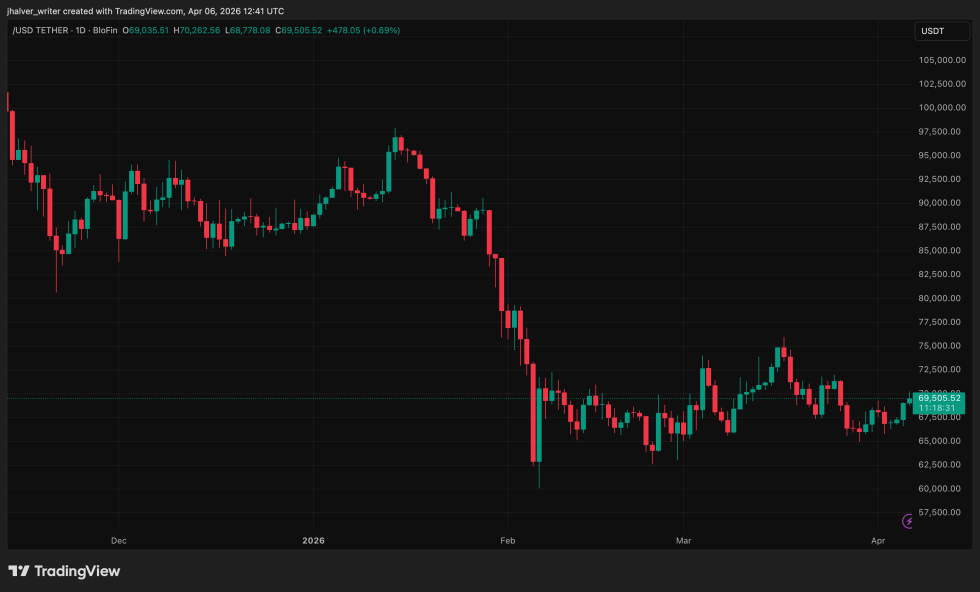
For the time being of writing, BTC trades for the highs $69k on the each day chart. Supply: BTCUSDT on Tradingview.
Cowl picture from Perplexity. BTCUSDT chart from Tradingview.
Editorial Course of for bitcoinist is centered on delivering completely researched, correct, and unbiased content material. We uphold strict sourcing requirements, and every web page undergoes diligent evaluate by our staff of high know-how consultants and seasoned editors. This course of ensures the integrity, relevance, and worth of our content material for our readers.

