To ensure that Web3 tasks to launch rapidly, devs will need to have a straightforward solution to combine Web3 into their tech stack. That is the place having a succesful NodeJS EVM API comes into the image. If you happen to’d prefer to create killer dapps (decentralized functions) with out breaking a sweat with JavaScript, this Web3 API is essential! Moreover, Moralis streamlines the method of utilizing this NodeJS EVM API and allows you to put it to use free of charge. Herein, we exhibit precisely the way to get began utilizing this API, however first, we have to be sure you all know the fundamentals. Thus, we should first look at what NodeJS and EVM are. Then, we’ll briefly clarify what APIs are. Lastly, we illustrate how one can acquire your Moralis API key, which can be your gateway to utilizing the last word NodeJS EVM API!
After masking the fundamentals of Moralis’ NodeJS EVM API, we’ll do a walkthrough of the way to use the NodeJS SDK. As such, be sure you create your free Moralis account so you may observe our lead. Furthermore, with the information and abilities obtained on this article, you’ll be able to sort out your individual concepts simply.
Until you’ve been residing underneath a rock, you recognize that Moralis is the last word Web3 backend platform. It gives you with three core Web3 improvement options – Web3 authentication, Web3 syncs, and Web3 APIs. Moreover, Moralis is cross-platform interoperable. Accordingly, you need to use your favourite legacy platforms and Web2 improvement abilities to affix the Web3 revolution. Additionally, Moralis helps a number of blockchains, which allows you to deploy your dapps to varied networks utilizing the identical strains of code. In consequence, you achieve extra attain and future-proof your work.

What’s NodeJS?
NodeJS, or Node.js, is a programming platform or atmosphere that got here to life in 2009. Its most important function was to assist handle among the complexities of JavaScript. Moreover, NodeJS is appropriate for internet improvement within the age of blockchain. This programming platform is constructed on Chrome’s JavaScript runtime. Furthermore, NodeJS makes it simpler for builders to construct scalable, high-performance apps. It achieves that with its framework that has the next necessary traits:
- Using an Occasion-Pushed, Non-Blocking I/O Mannequin – The latter ensures that the node course of doesn’t lock up the complete internet app when retrieving a sole response. As a substitute, it merely strikes on to the subsequent occasion and frequently runs till the occasion queue is empty. Additionally, NodeJS introduces a novel occasion mannequin. The latter doesn’t simply use a library as a runtime constructor but additionally an occasion loop. Additional, this mannequin doesn’t require a blocking name to begin an occasion loop. Because of this attribute, NodeJS gives a framework that’s light-weight, environment friendly, and extremely becoming for real-time functions throughout decentralized networks.
- Working on Each Shopper-Aspect and Server-Aspect – This NodeJS attribute enhances using JavaScript. By permitting internet functions to run with real-time, two-way connections, each server and shopper can provoke communications and freely change knowledge.
- Enabling Builders to Reuse Code – NodeJS packing supervisor (NPM) is thought for code reuse. In spite of everything, there are over one million packages out there for builders to make use of in programming duties. Furthermore, the power to reuse code significantly advantages builders who run JavaScript-heavy functions. It allows them to keep away from the added burden of context switching between edit and search instruments.
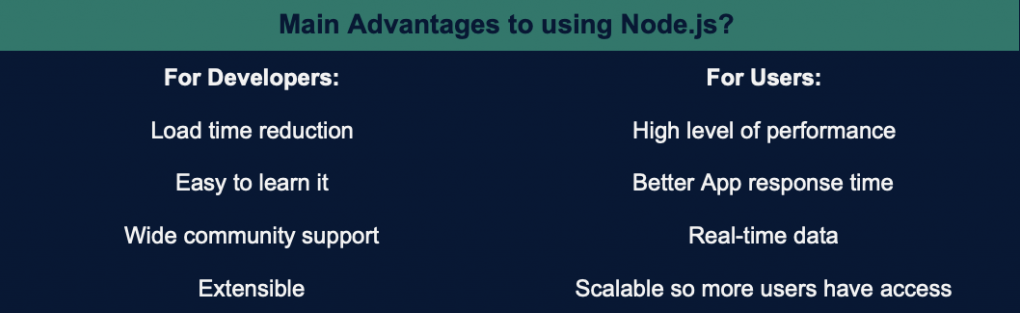
Finally, NodeJS allows real-time knowledge change and communication, which is crucial when coping with public blockchains.
What’s EVM?
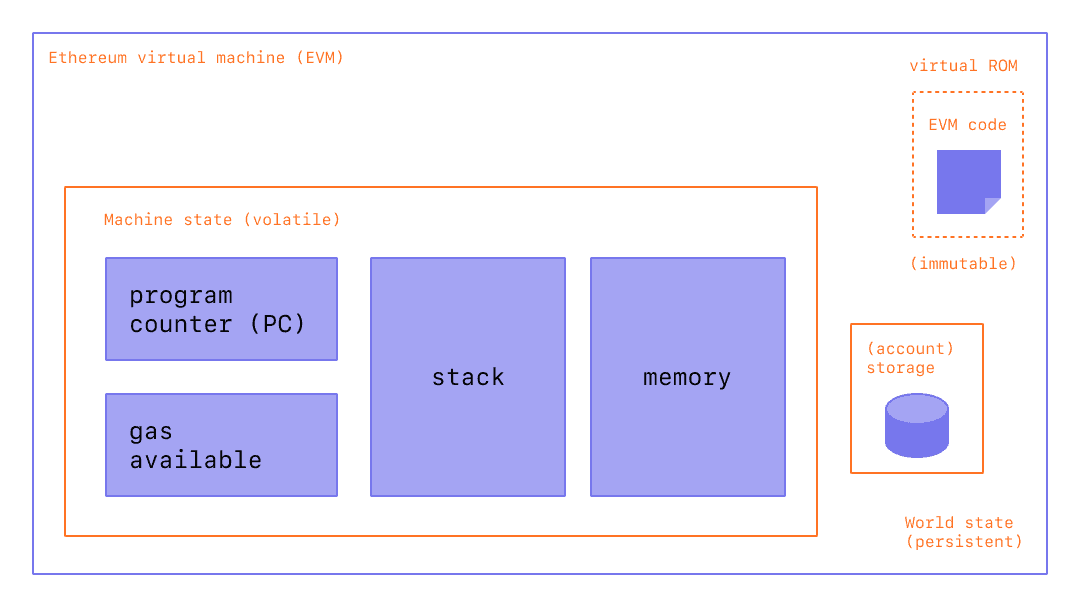
Ethereum Digital Machine, or EVM, is a Turing-complete digital machine that allows code execution precisely as meant. Thus, it’s the runtime atmosphere for all sensible contracts on Ethereum and different EVM-compatible chains. This makes EVM the engine that powers Ethereum and different EVM-compatible chains; in spite of everything, sensible contracts are the core packages behind all cryptocurrencies and dapps.
If that is your first time listening to about Turing-completeness and digital machines, ensure to learn our “EVM Defined” and “The Final EMV API” guides. The latter will even give you a neat rationalization of what sensible contracts are.
Let’s additionally contemplate the next definition of APIs. API stands for “utility programming interface”, which is an interface that allows software program to work together with different items of software program. Moreover, APIs assist this sort of communication by enabling completely different units of directions to be translated or someway transferred for mutual understanding. Additionally, APIs allow devs to make use of current API units of their apps and keep away from losing money and time or reinventing the wheel.
Now we will tie all of it collectively and conclude {that a} NodeJS EVM API is a set of directions, definitions, and protocols that allows communication amongst items of software program operating on EVM and a JavaScript-based frontend.
Utilizing the Final NodeJS EVM API
As talked about on the outset of this text, Moralis give you the last word NodeJS EVM API. The latter is totally modularized and fairly straightforward to make use of. It is likely one of the easiest methods to combine Web3 functionalities into any backend. Moreover, it gives full TypeScript (TS) assist. Through the use of the NodeJS EVM API, you may effortlessly question all kinds of blockchain knowledge. This contains NFTs (non-fungible tokens), fungible tokens, balances, transactions, and way more. Moreover, due to Moralis’ cross-chain interoperability, you need to use this NodeJS EVM API on all main programmable blockchains!
To make use of Moralis’ NodeJS EVM API, it’s essential to full the next steps:
- Create a NodeJS Web3 utility
- Import and setup the newest Moralis NodeJS SDK
- Setup a easy Categorical server
- Combine your utility with Moralis companies
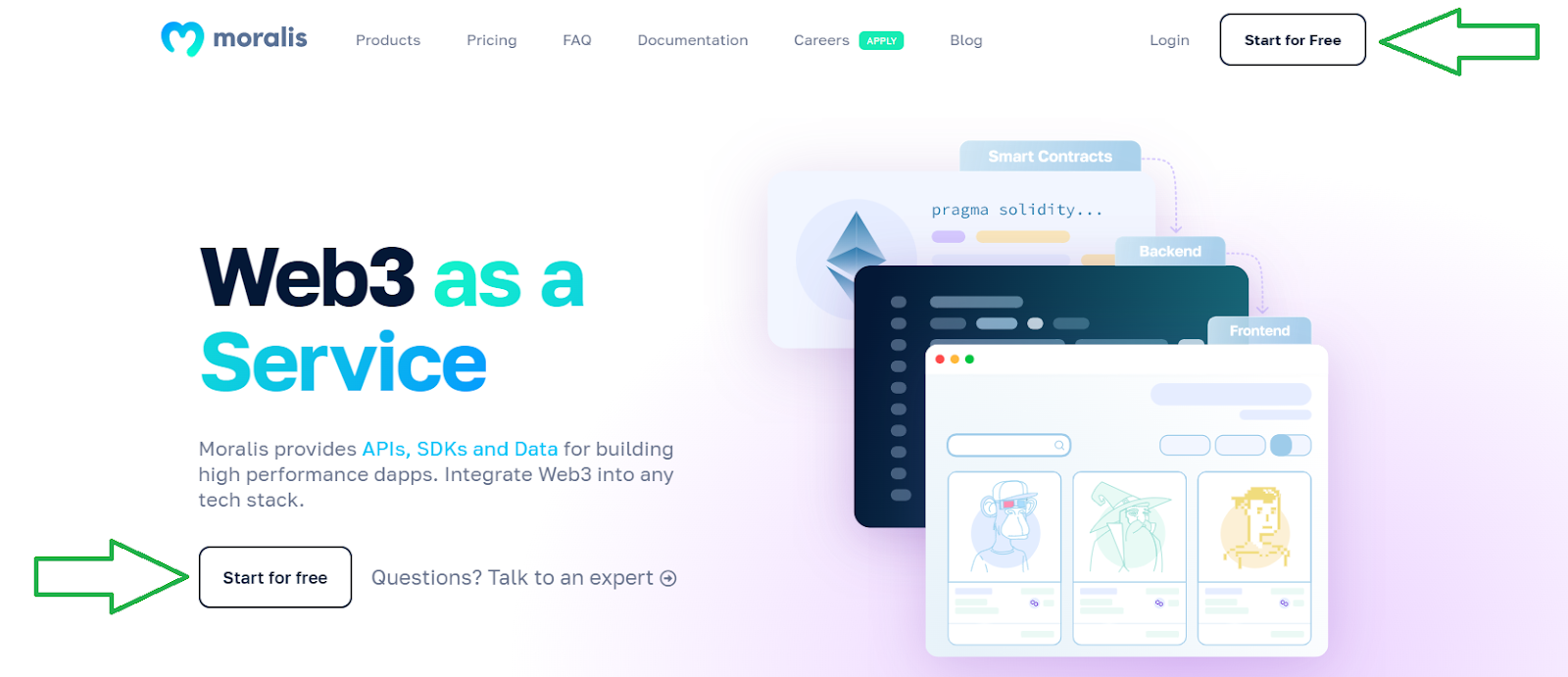
By finishing the above steps, you’ll be capable to learn all kinds of knowledge from all supported blockchains. After all, we’ll undergo some examples collectively. Additionally, to finish the above steps, it’s essential to create your Moralis account. You should utilize the “create your free Moralis account” hyperlink that we referred to initially on this article or go to the official Moralis web site and click on on the “Begin for Free” button:
On the subsequent web page, enter your credentials:

Don’t neglect to click on on the affirmation hyperlink within the e-mail despatched to your e-mail inbox. Subsequent, you additionally want to put in and arrange your favourite code editor or IDE. If you wish to observe our lead, be happy to make use of Visible Studio Code (VSC). Nonetheless, you’ll additionally want to put in NodeJS:

Getting Began with the Final NodeJS EVM API
Earlier than you initialize a brand new venture, ensure to create a brand new folder to your venture. Then open that folder in VSC. Subsequent, use VSC’s terminal and use the “npm init” command to initialize a brand new venture. Following the setup, it’s essential to give your venture a reputation and fill within the particulars in keeping with your preferences. If you happen to determine to go together with default settings, you may press enter. After the preliminary setup, it’s best to see the “package deal.json” file. Furthermore, you additionally want to put in the “Categorical” and “Moralis” dependencies. To do that, use the terminal once more and enter the “npm set up moralis categorical” command.
Subsequent, create the “index.js” file that may maintain the Categorical server setup:
const categorical = require('categorical')
const app = categorical()
const port = 3000

app.get('/', (req, res) => {
  res.ship('Whats up World!')
})

app.pay attention(port, () => {
  console.log(`Instance app listening on port ${port}`)
})
Additionally, ensure so as to add the next script to your “package deal.json” file:
"scripts": {
  "begin": "node index.js"
},
You at the moment are able to run your Categorical server with the “npm run begin” command. Then, you may examine in case your server is operating by going to the next URL:
http://localhost:3000
To truly use Moralis’ NodeJS EVM API, you additionally want so as to add Moralis to your dapp. To do that, you could get your Web3 API key out of your Moralis dashboard, which you’ll solely entry for those who’ve created your Moralis account (as instructed above). As soon as inside your Moralis dashboard, click on on the profile icon within the top-right nook. Then, click on on account settings and choose the “Keys” tab. There, you’ll get to repeat your Web3 API key:

Lastly, you’ll want to stick your API key into your code.
Including Moralis’ Web3 API Key to Your Code
You’ve gotten a number of choices in the case of including your Moralis Web3 API key to your code. For example, you may observe the directions within the official Moralis documentation and add it on to the beforehand created “index.js” file. Or, you may have a separate “.env” file that may maintain this worth (for particulars, see the video on the backside of this text):

In both case, you will have to import Moralis from ‘moralis’ and “EvmChain” knowledge sort kind ‘@moralisweb3/evm-utils’. Furthermore, additionally, you will want the “Moralis.begin” operate.
The Final NodeJS EVM API and “EvmChain”
Observe: For an in depth video tutorial on the way to deal with EVM-compatible chains, use the video beneath, beginning at 1:20.
Moralis’ NodeJS EVM API handles chains as a separate class occasion referred to as “Moralis dataTypes”. As such, you name “EvmChain” adopted by a dot after which the chain. Listed here are some examples:
- EvmChain.ETHEREUM
- EvmChain.ROPSTEN
- EvmChain.BSC
- EvmChain.POLYGON
- EvmChain.AVALANCHE
- EvmChain.FANTOM
You may also do the above utilizing “EvmChain.create()”, the place you could enter the chain title or ID into the parentheses. Right here’s an instance:
- EvmChain.create(“ETHEREUM”) or EvmChain.create(1)
To see how the above values are logged, use the video beneath beginning at 2:05. There, you’ll additionally see the next utility strategies in motion:
- “.decimal”
- “.hex”
- “.title”
- “.forex”
- “.format” (for this one, you could set your individual formatting)
- “.equals()”

The Final NodeJS EVM API and “EvmAddress”
Observe: For an in depth video tutorial on the way to use “EvmAddress”, take a look at the video beneath, beginning at 3:51.
To make use of the last word NodeJS EVM API to create new addresses, you employ “EvmAddress.create()”. Furthermore, the tackle wants to come back contained in the parentheses, like so:
EvmAddress.create("0x1234567890123456789012345678901234567890")Within the instance above, we use lowercase, however it additionally works with uppercase letters. Furthermore, listed here are some frequent utility strategies:
- “.lowercase”
- “.checksum”
- “.equals()”
- “.format()” (for this one, you could set your individual formatting)

“EvmAPI” and “Moralis.Auth”
Observe: For an in depth video tutorial on the way to use “EvmAPI”, take a look at the video beneath, beginning at 4:33.
Utilizing “EvmAPI” offers you the unimaginable energy of our NodeJS EVM API. Identical to with “EvmChain” and “EvmAddress”, “EvmAPI” follows “Moralis.” and is adopted by sorts of APIs and API endpoints. Right here’s an instance that may get token balances for an account:
"Moralis.EvmApi.account.getTokeBalances()”
Utilizing “.toJSON“, “.uncooked“, and “.consequence” knowledge varieties allows you to choose the format of return values.
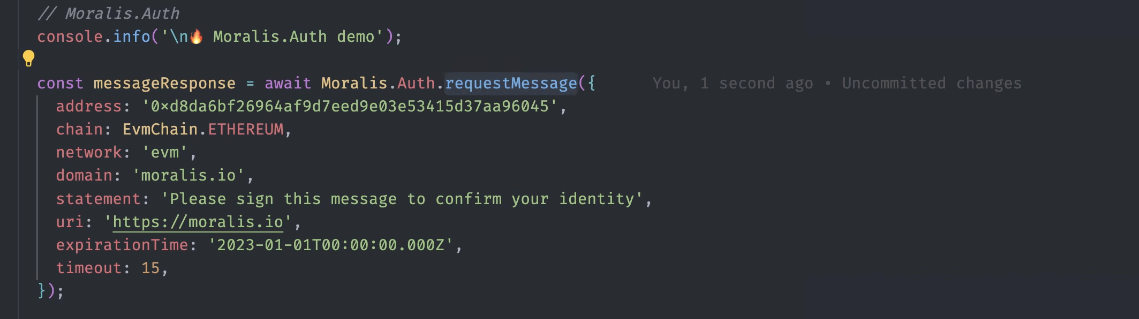
The NodeJS EVM API additionally offers you entry to the Moralis Web3 Auth API (7:55). Moreover, “Moralis.Auth” has two strategies – “requestMessage” and “confirm”.
Sooner or later, we’ll launch extra information on the way to make the most of the Moralis Web3 Auth API. Nonetheless, right here’s an instance on how the code would appear to be:
Final however not least, right here’s the video tutorial the place our in-house knowledgeable will give you extra particulars concerning the Moralis NodeJS EVM API:
Exploring the Final NodeJS EVM API – Abstract
On this article, you had an opportunity to study concerning the Moralis NodeJS EVM API. We began by explaining what NodeJS and EVM are. Plus, we went via briefly what an API is. With the fundamentals underneath our belts, we centered on really utilizing this final NodeJS EVM API. That is the place we examined the steps you could take to get began. As such, you found that one of many conditions contains acquiring your Moralis Web3 API key. Now you recognize that the latter awaits you within the “keys” tab contained in the account settings of your Moralis dashboard. As we moved ahead, you additionally had a chance to take a more in-depth have a look at “EvmChain“, “EvmAddress“, “EvmAPI“, and “Moralis.Auth“.
We hope this text allows you to see that you need to use your current JavaScript proficiency and begin creating Web3 apps effortlessly. Through the use of Moralis’ NodeJS EVM API, you may commit your consideration to creating the very best frontend whereas Moralis covers your backend wants. If you have already got some cool dapp concepts, ensure to roll up your sleeves and get to it. Nonetheless, in case you have an interest in tackling some wonderful tutorials first, ensure to take a look at the Moralis weblog and the Moralis YouTube channel. Basically, these two shops allow you to grow to be a Web3 developer free of charge.
However, you may be keen on taking a extra skilled strategy. If that’s your cup of tea, enrolling in Moralis Academy may be the arrogance enhance you want. By turning into blockchain licensed, you’ll considerably enhance your probabilities of going full-time crypto sooner somewhat than later.

