Are you interested by studying tips on how to create an AWS Lambda perform? If so, you’re in luck! This text supplies a complete tutorial for making a Lambda perform. For example the method, we’ll present you tips on how to combine Moralis’ NodeJS SDK with AWS by creating and deploying a Lambda software with a number of features. What’s extra, because of the accessibility of Moralis, it is possible for you to to take action in solely three steps:
- Stipulations
- Configuring AWS and Setting Up a Venture
- Creating the Lambda App
By following the steps above, you’ll learn to create, take a look at, deploy, and run an AWS Lambda perform. Because of this, it is possible for you to to run JavaScript code instantly by Lambda! If you’re keen to leap into the tutorial instantly, be at liberty to skip to the “Lambda Perform Instance – Demonstration of Learn how to Create an AWS Lambda Perform” part. You can too discover the whole code for the venture within the following GitHub repository:
Overview
Amazon Net Companies (AWS) is likely one of the most well-established and complete cloud computing platforms utilized by tens of millions of consumers. AWS options an in depth ecosystem of web-related companies, one in all which is AWS Lambda. AWS Lambda is an event-driven, serverless computing service permitting you to run code with out worrying concerning the underlying infrastructure. Consequently, to run packages, all that’s required of you is to add the code within the type of AWS Lambda features. Nevertheless, what are they, and the way do you create an AWS Lambda perform?
In order for you the reply to the query above, learn on as we discover the intricacies of Lambda features and tips on how to create them. By following alongside on this article, you’ll quickly learn to run JavaScript code through AWS Lambda! Nevertheless, suppose you might want to familiarize your self additional with what this service entails and are searching for a extra detailed breakdown. In that case, we extremely suggest testing our information on AWS Lambda and what it’s used for earlier than persevering with!
If you happen to already know tips on how to create an AWS Lambda perform however have additional curiosity in Web3 improvement, try further Moralis content material right here at our Web3 weblog. For instance, be taught to create Polygon webhooks or learn up on Web3 for enterprise!
Nonetheless, if you wish to be part of us on this tutorial, enroll with Moralis, as you want an account to create an AWS Lambda perform!
What’s AWS Lambda and Lambda Features?
AWS Lambda is a serverless and event-driven computing service equipped by Amazon Net Companies (AWS). Lambda lets you run code from any backend service or software with out the need to provision or handle servers. Consequently, AWS Lambda takes care of the whole computing infrastructure, and also you solely want to supply the code you need to execute!
All code equipped to AWS Lambda is organized into ”Lambda features”. Lambda features comprise configuration data resembling useful resource necessities, a reputation, an entry level, and so on. Furthermore, since Lambda options an event-driven structure, the service runs the features in response to occasions. Some outstanding examples of occasions may be HTTP requests, DynamoDB desk updates, object modifications in Amazon S3, and so on.
For the reason that features are triggered based mostly on occasions, Lambda solely invokes them when requested. This, mixed with the ”pay-as-you-go” fee construction, ensures you solely pay for the computing useful resource you eat. Consequently, you may achieve a number of benefits from Lambda, resembling diminished prices and extra versatile scalability alternatives!
If you wish to know extra concerning the ins and outs of this service, we extremely suggest our article explaining AWS Lambda features and structure in additional element.
Nonetheless, with a greater understanding of what this service entails, the next part dives deeper into the method of making a Lambda perform!
The Strategy of Making a Lambda Perform
Now that you’re extra aware of AWS Lambda, this part supplies a “course of overview” of making a Lambda perform. That stated, there are various methods to create an AWS Lambda perform, and you’ve got a number of choices. In reality, you may writer features within the following 4 methods:
- AWS Command Line Interface (CLI) – Your first choice for making a Lambda perform is thru the AWS CLI. The CLI helps macOS, Home windows, and Linux (extra on how the CLI is used within the ”Lambda Perform Instance…” part).

- AWS Administration Console – The second choice is to make use of the web-based AWS Administration Console instrument. The Lambda console provides a code editor permitting you to check and modify code shortly.
- CloudFormation – It’s attainable to make use of AWS CloudFormation, an infrastructure-as-code (IaC) service, to create templates that outline features.
- AWS SDKs – Your remaining choice is to make use of AWS SDKs. It is a good choice if you wish to instantly create an AWS Lambda perform utilizing language-specific APIs.
Nonetheless, that covers 4 methods to create an AWS Lambda perform. Nevertheless, the next part breaks down a Lambda perform instance to make this much more comprehensible. As such, if you would like an indication of tips on how to create an AWS Lambda perform, learn on!
Lambda Perform Instance – Demonstration of Learn how to Create an AWS Lambda Perform
With a extra profound understanding of AWS Lambda and the intricacies of the service’s features, it’s time to dive into the central a part of this tutorial. As such, the next sections will illustrate tips on how to create a Lambda perform. Moreover, to display the method, this tutorial will present you tips on how to effortlessly combine Moralis’ NodeJS SDK with Lambda. It’s attainable to take action in a number of other ways; nonetheless, for this information, we might be growing and deploying a Lambda software that includes two blockchain-related features: ”getNativeBalance()” and ”getWalletNfts()”.

As Moralis makes Web3 improvement considerably extra accessible, you may create an AWS Lambda perform in three easy steps:
- Stipulations
- Configuring AWS and Setting Up a Venture
- Creating the Lambda App
By following these steps, you’ll learn to seamlessly combine Moralis’ NodeJS SDK with AWS to create an AWS Lambda perform very quickly. Because of this, you achieve the power to run Web3 JavaScript features with Lambda, which is able to most certainly show useful in future blockchain improvement endeavors!
If this sounds thrilling, be part of us and learn to create an AWS Lambda perform within the following sections. To kick issues off, allow us to begin by protecting the obligatory stipulations!
Step 1: Stipulations
To create an AWS Lambda perform, you might want to cowl the next seven stipulations:
- Setting Up a Moralis Account – To start with, the very first thing you want is a Moralis account. So, in case you have not already, enroll with Moralis immediately!
- Creating an AWS Account – Along with signing up with Moralis, you want an AWS account to create an AWS Lambda perform.
- Putting in an IDE – To put in writing the code for the app, you might want to set up an IDE. If you’re not sure what IDE to go for, think about VSC, the surroundings used throughout this tutorial.
- Putting in NodeJS – With an IDE at hand, you additionally want to put in the NodeJS runtime surroundings, which you’ll obtain by clicking right here.
- Setting Up the AWS CLI – Subsequent up, set up and arrange the AWS CLI.
- Putting in Serverless Framework – Set up Serverless Framework, as that is used to arrange the venture.
- Creating an IAM Consumer – Lastly, you need to create an IAM person. To take action, log in to AWS and open the IAM console. From there, click on on ”Customers” and ”Add person” within the navigation bar, taking you to the next web page:

It’s worthwhile to add a username and examine the packing containers for every credential kind. From there, transfer on to the second half and fix ”AdministratorAccess” as a coverage:

Lastly, cowl every remaining step and configure the IAM person in accordance with your preferences. Nevertheless, when you attain the ultimate half, notice that you might want to obtain your AWS credentials as a ”.csv” file:
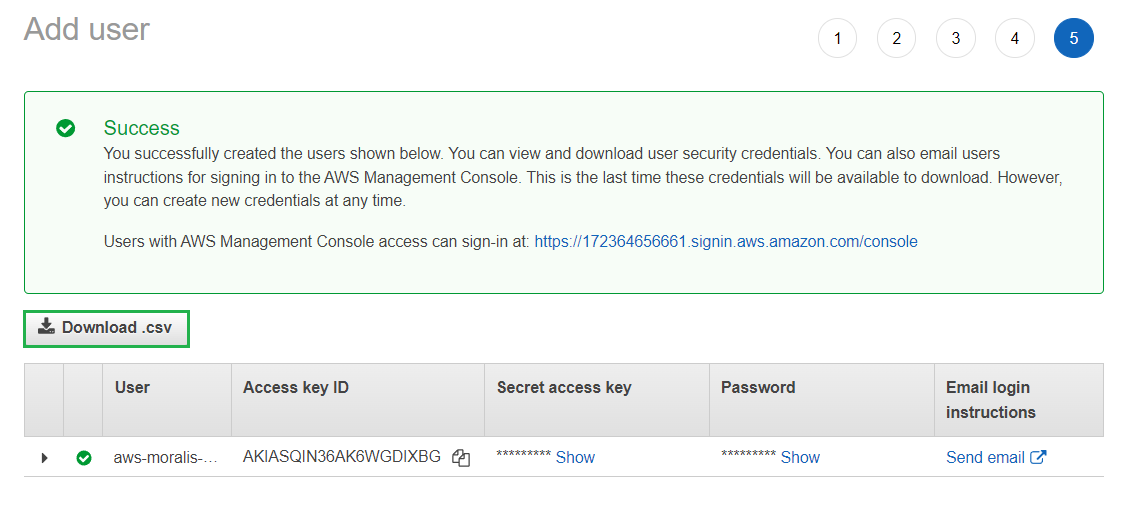
Step 2: Configuring AWS and Setting Up a Venture
Now that you’ve lined the obligatory stipulations, this step revolves round configuring AWS and establishing a brand new venture. The part begins with the previous, exhibiting you tips on how to configure your AWS credentials!
To kick issues off, you might want to open a brand new terminal. If you happen to determined to go for VSC as your IDE, you could possibly achieve this by clicking on ”Terminal” on the prime, adopted by ”New Terminal”:

As quickly because the terminal launches, go forward and run the command under:
aws configure
This can autonomously immediate your terminal, and you might want to add your ”AWS Secret Entry Key” and ”AWS Entry Key ID”. In the long run, it ought to look one thing like this:
AWS Entry Key ID [None]: AKIAIOSFODNN7EXAMPLE
AWS Secret Entry Key [None]: wJalrXUtnFEMI/K7MDENG/bPxRfiCYEXAMPLEKEY
Default area identify [None]: ENTER
Default output format [None]: ENTER
That covers the AWS credential configurations. The following subsection exhibits you tips on how to arrange a brand new venture with Serverless Framework!
Setting Up a Venture
To arrange the venture, begin by creating a brand new folder. From there, open the folder along with your IDE and run the command under within the terminal:
serverless
Once you run the ”serverless” command, the terminal supplies you with a number of choices. On this occasion, you need to select the ”Starter” different:

Subsequent up, add a reputation to the venture, which you are able to do by instantly hitting enter to set a default identify. Nevertheless, you too can enter a customized identify your self:

When you identify the venture, a brand new Serverless Framework template will mechanically obtain to your native repository. When the obtain completes, the terminal will immediate you to log in. Nevertheless, for this tutorial, it’s not crucial, and you’ll progress by inputting ”n” and hitting enter:

The terminal will then ask if you wish to deploy the venture. You possibly can maintain off on that for now. Proceed by inputting ”n” once more after which hit enter:

When you hit enter, you need to end up with a pattern venture within the IDE just like the one under:

Nevertheless, earlier than persevering with to the third step, you might want to make a number of configurations for the venture. To start with, create a brand new folder referred to as ”features”:

From there, transfer the ”handler.js” file into ”features”:

You possibly can then open ”serverless.yml” and set a brand new location for the ”handler.js” file:

Lastly, you need to add your Moralis API key by changing the code within the ”serverless.yml” file with the contents under:
service: aws-node-project

frameworkVersion: '3'

supplier:
  identify: aws
  runtime: nodejs14.x
  surroundings:
    MORALIS_API_KEY: 'replace_me'

features:
  hi there:
    handler: features/handler.hi there
Furthermore, should you examine the code above, you’ll shortly discover that you might want to substitute the ”replace_me” parameter along with your Web3 API key. You could find the important thing by logging into Moralis and navigating to the ”Web3 APIs” tab:

Step 3: Creating the Lambda App
Now, with the preliminary template at your disposal, it’s time to take a more in-depth have a look at the central a part of this tutorial and present you tips on how to create a Lambda perform. To start with, you might want to set up the Moralis dependencies. As such, open a brand new terminal and ”cd” into the foundation folder of the venture. From there, set up Moralis by working the command under:
npm set up moralis
Within the following subsections, we’ll cowl the 2 features of the app: ”getNativeBalance()” and ”getWalletNfts()”. The primary perform will fetch the native token steadiness of a Web3 pockets; in the meantime, the second returns the pockets’s NFTs. Nonetheless, let’s begin with ”getNativeBalance()”.
The “getNativeBalance()” Perform
First up, go forward and alter the identify of the present ”handler.js” file to ”getNativeBalance.js”:

Subsequent up, proceed by opening the file and changing ”module.exports.hi there” with ”module.exports.handler”:

Additionally, ensure that to vary the perform identify and handler in “serverless.yml”:

From there, you might want to add Moralis’ ”getNativeBalance” performance. To take action, begin by inputting the Moralis necessities on the prime of the file:
const Moralis = require('moralis').default;
You possibly can then proceed by initializing Moralis along with your API key by including the next code snippet:
const startMoralis = async () => {
  await Moralis.begin({
    apiKey: course of.env.MORALIS_API_KEY
  });
};

startMoralis();
Lastly, substitute the ”module.exports.handler” a part of the file with the code under, which implements the SDK methodology for fetching the native steadiness of a pockets:
module.exports.handler = async (occasion) => {
  // Get native steadiness
  const nativeBalance = await Moralis.EvmApi.steadiness.getNativeBalance({
    tackle: occasion.tackle,
    chain: occasion.chain
  });

  // Format the native steadiness formatted in ether through the .ether getter
  const nativeBalanceEther = nativeBalance.consequence.steadiness.ether;

  return {
    consequence: nativeBalanceEther
  }
};
Finally, this ought to be the ultimate state of the ”getNativeBalance.js” file:
'use strict';
const Moralis = require('moralis').default;

const startMoralis = async () => {
  await Moralis.begin({
    apiKey: course of.env.MORALIS_API_KEY
  });
};

startMoralis();

module.exports.handler = async (occasion) => {
  // Get native steadiness
  const nativeBalance = await Moralis.EvmApi.steadiness.getNativeBalance({
    tackle: occasion.tackle,
    chain: occasion.chain
  });

  // Format the native steadiness formatted in ether through the .ether getter
  const nativeBalanceEther = nativeBalance.consequence.steadiness.ether;

  return {
    consequence: nativeBalanceEther
  }
};
That’s it for the primary perform! Let’s comply with the identical steps to implement the ”getWalletNfts()” perform within the part under!
The “getWalletNfts()” Perform
To create the ”getWalletNfts()” perform, you might want to add a brand new file to the ”features” folder and identify it ”getWalletNfts.js”:

From there, open the file and add the next code:
'use strict';
const Moralis = require('moralis').default;

const startMoralis = async () => {
  await Moralis.begin({
    apiKey: course of.env.MORALIS_API_KEY,
  });
};

startMoralis();

module.exports.handler = async (occasion) => {
  // Get pockets NFTs
  const nfts = await Moralis.EvmApi.nft.getWalletNFTs({
    tackle: occasion.tackle,
    chain: occasion.chain,
    restrict: 10
  });

  return {
    consequence: JSON.stringify(nfts)
  }
};
Lastly, to prime issues off, open the ”serverless.yml” file and add the code snippet under to the ”features” part of the file:
getWalletNfts:
    handler: features/getWalletNfts.handler

Congratulations! You’ve gotten now accomplished the method of making a Lambda perform! Nevertheless, earlier than shifting on, it’s a good suggestion to run a take a look at to make sure all the pieces works. As such, progress by creating a brand new ”occasion.json” file within the root folder of the venture:

You then want so as to add ”tackle” and ”chain” parameters to the file, which is able to look one thing like this (ensure that so as to add the tackle you need to question data from and the proper chain ID):
{
    "tackle": "0x99EXAMPLEADDRESS",
    "chain": "chain_id"
}
Subsequent up, you may take a look at both of the features by opening a terminal and working the command under:
serverless invoke -f FUNCTION_NAME --path occasion.json
Nevertheless, discover that you need to substitute ”FUNCTION_NAME” with one of many features’ names. Consequently, should you resolve to check ”getNativeBalance()”, the terminal ought to return the next message if the perform works:

That’s mainly it! All that is still from right here is deploying the appliance to AWS Lambda, and we’ll cowl this within the following bonus step!
Bonus Step: Deploy Your AWS Lambda Perform
Now that you’re profitable in making a Lambda perform, all that is still is importing the venture to AWS Lambda. Luckily, deploying AWS Lambda features is comparatively easy. Open a terminal, guarantee that you’re within the venture’s root folder, and run the next command:
serverless deploy
If the appliance efficiently deploys, the terminal ought to return a message just like the one under:

That covers the whole AWS Lambda NodeJS tutorial from begin to end! You now know tips on how to create an AWS Lambda perform and deploy it to the service. As such, now you can run JavaScript code through Lambda and use your newly acquired expertise in all future Web3 improvement endeavors!
If you happen to skilled bother through the tutorial, ensure that to take a look at Moralis’ AWS Lambda Web3 documentation. The docs cowl the method from begin to end and can most certainly reply any questions you might need!
Abstract – Learn how to Create an AWS Lambda Perform
On this tutorial, you discovered tips on how to create an AWS Lambda perform, and because of Moralis, you had been ready to take action in solely three steps:
- Stipulations
- Configuring AWS and Setting Up a Venture
- Creating the Lambda App
Following the tutorial, you may simply construct, take a look at, deploy, and run JavaScript code by AWS Lambda. As such, now that you’re aware of creating AWS Lambda features, you may mix your newly acquired data with further Moralis instruments to construct subtle Web3 tasks!
If this sounds fascinating, think about testing different Moralis instruments, like the varied Web3 APIs. Amongst them, you’ll discover the Auth API. With this instrument, you may simply implement a number of authentication mechanisms into your blockchain tasks. If this sounds thrilling, try our articles on tips on how to add an indication in with RainbowKit or add Coinbase Pockets login performance! So, if you wish to entry a extra seamless developer expertise and use instruments like Moralis’ Web3 APIs, enroll with Moralis instantly!

