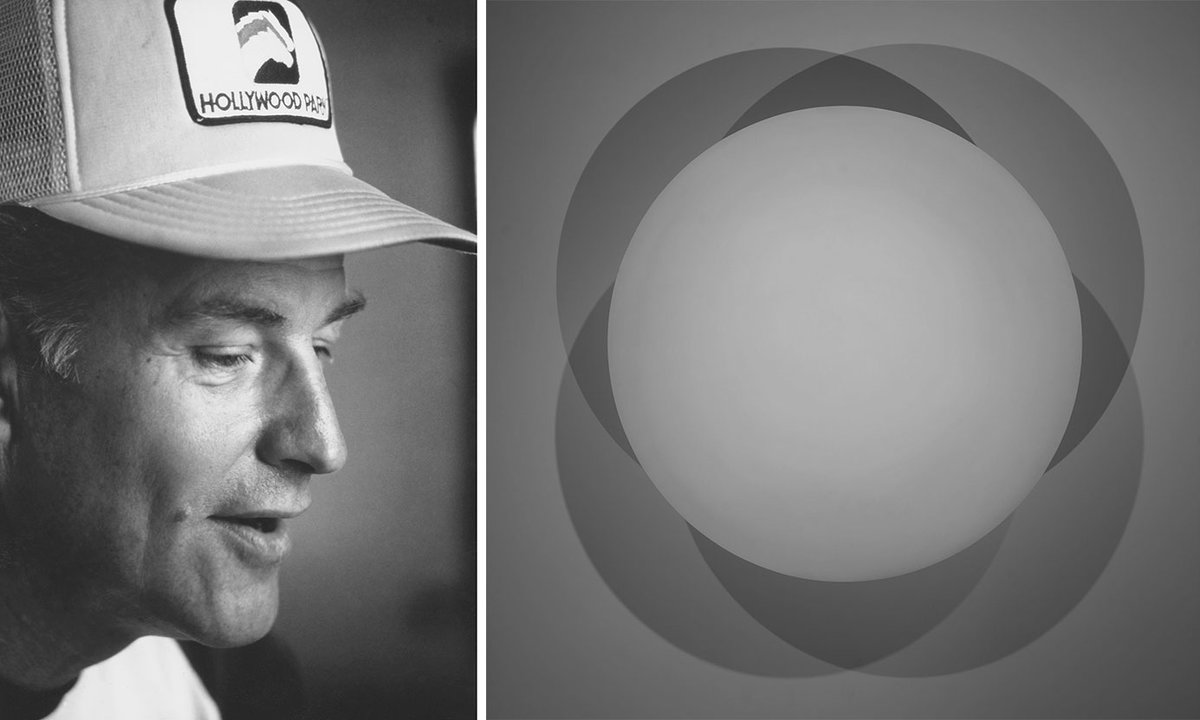
Robert Irwin, a pioneering determine within the Californian Mild and Area Motion, and a vastly influential maker of experiential, minimal, generally site-specific and infrequently short-term works, has died, aged 95. Irwin’s demise, at Scripps Memorial Hospital, was attributable to coronary heart failure, in response to Arne Glimcher, the founder and chairman of the worldwide Tempo Gallery, which has represented the artist since 1966.
“In my lengthy profession, I’ve been privileged to work with a number of the best artists of the twentieth century and develop deep friendships with them,” Glimcher mentioned, “however none larger or nearer than Robert Irwin. In our 57-year relationship, his artwork and philosophy have prolonged my notion, formed my style, and made me realise what artwork might be.”
Irwin latterly contributed famous design work for gallery and panorama areas for museums together with the Getty Museum in Los Angeles (1997), the place he designed the terraces and gardens round Richard Meier’s sprawling new hilltop constructing, and Dia:Beacon (2005) in higher New York State.
In 2017, the Chinati Basis in Marfa, Texas, opened untitled (daybreak to nightfall), his first freestanding construction. It was 17 years in conception and noticed Irwin—in his mid-eighties by the point it was created—rework a former military hospital on Chinati’s campus into a ten,000 sq. ft, horseshoe-shaped set up that progresses from mild to darkish. Home windows put in at eye degree reveal a skinny strip of panorama and an enormous expanse of the Texan sky.
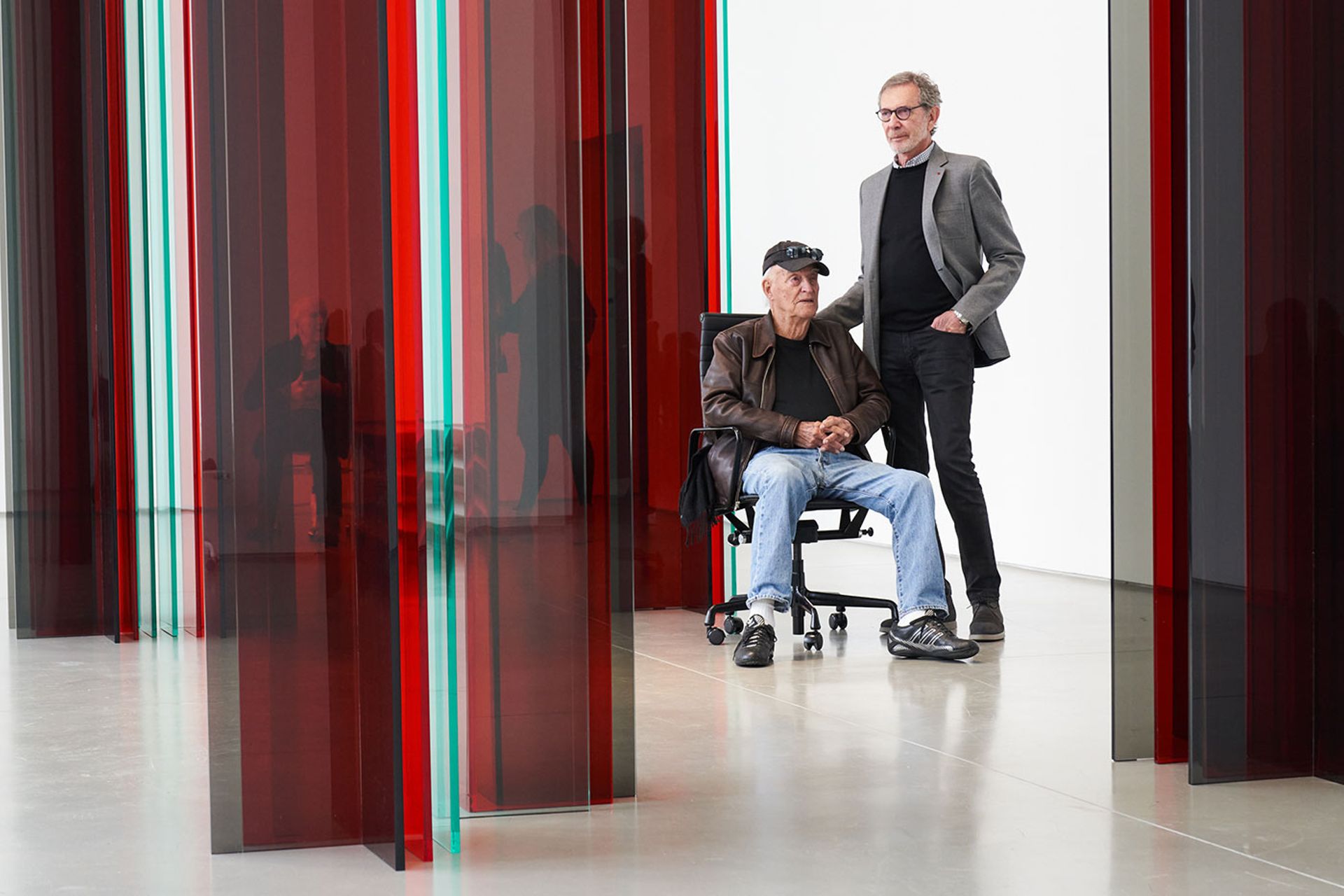
Robert Irwin (left), and Arne Glimcher, founder and chairman of the worldwide Tempo Gallery, 2022 Courtesy Tempo Gallery
The loosely aligned Mild and Area motion, the Golden State’s personal artwork type, whose major proponents included Irwin and his youthful modern James Turrell, discovered its identify when the College of California, Los Angeles (UCLA) hosted Transparency, Reflection, Mild, Area: 4 Artists (1971), that includes the work of Irwin, Peter Alexander, Larry Bell and Craig Kauffman. Forty years later the Museum of Modern Artwork San Diego offered a landmark survey of the motion, Phenomenal: California Mild, Area, Floor (2011).
Irwin’s works with mild break down in to 2 major varieties, people who handle pure mild—generally via window openings, generally via the subtlest of scrims—and people constructed on fluorescence.
Mild artists interviewed by The Artwork Newspaper for a latest article on mild and expertise, universally cited Irwin as an vital modern affect. To Hannes Koch, co-founder of the European collaborative studio Random Worldwide, it was “all the time Robert Irwin”. And that affect got here not simply from Irwin’s celebrated use of sunshine (each pure and fluorescent), however in his examine of notion—the artist‘s and the viewer‘s—and of utilizing that to contain his viewers, effortlessly and instinctively, in his works. On the 1971 UCLA present, Irwin’s stairwell set up had been “activated . . . perceptually with as little occasion or object as doable”.
Irwin was a son of California, born in Lengthy Seashore, south of Los Angeles. He was the son of a shipyard employee and served within the army in Europe earlier than returning to the West Coast the place, from 1948, he studied at three artwork colleges: Otis Artwork Institute, the Jepson and the Chouinard, now CalArts.
On a return journey to Europe within the mid Fifties he toured museums, learning the Outdated Masters and—virtually on a whim—took a ship to Ibiza, within the Balearic Islands, then a sleepy, bohemian idyll. There he had his first encounter with (self)-perception, spending, like some unintentional Desert Father, eight months alone in an remoted cottage, conversing with nobody. It was, he later mentioned, a decisive second in his formation as an artist. “I realised I used to be within the twentieth century,” he later advised his good friend and biographer Lawrence Weschler. “And I wasn’t in any respect occupied with historic types.”
Again in Los Angeles Irwin practised his personal model of Summary Expressionism, whereas nonetheless trying to find his personal creative voice. Los Angeles was prosperous however conservative within the Fifties, with out a longtime artwork scene, however Irwin benefited from his reference to the Ferus Gallery in Venice Seashore, based by Walter Hopps in 1957, which helped set up the reputations of Irwin (who joined the gallery in 1958), and different equally and fiercely impartial artists as Robert Kienholz, Billy Al Bengston and Ed Ruscha.
Within the Nineteen Sixties, Irwin made his mark as an artist together with his aluminium disc work, and continued to take action together with his landmark mild items within the Nineteen Seventies.
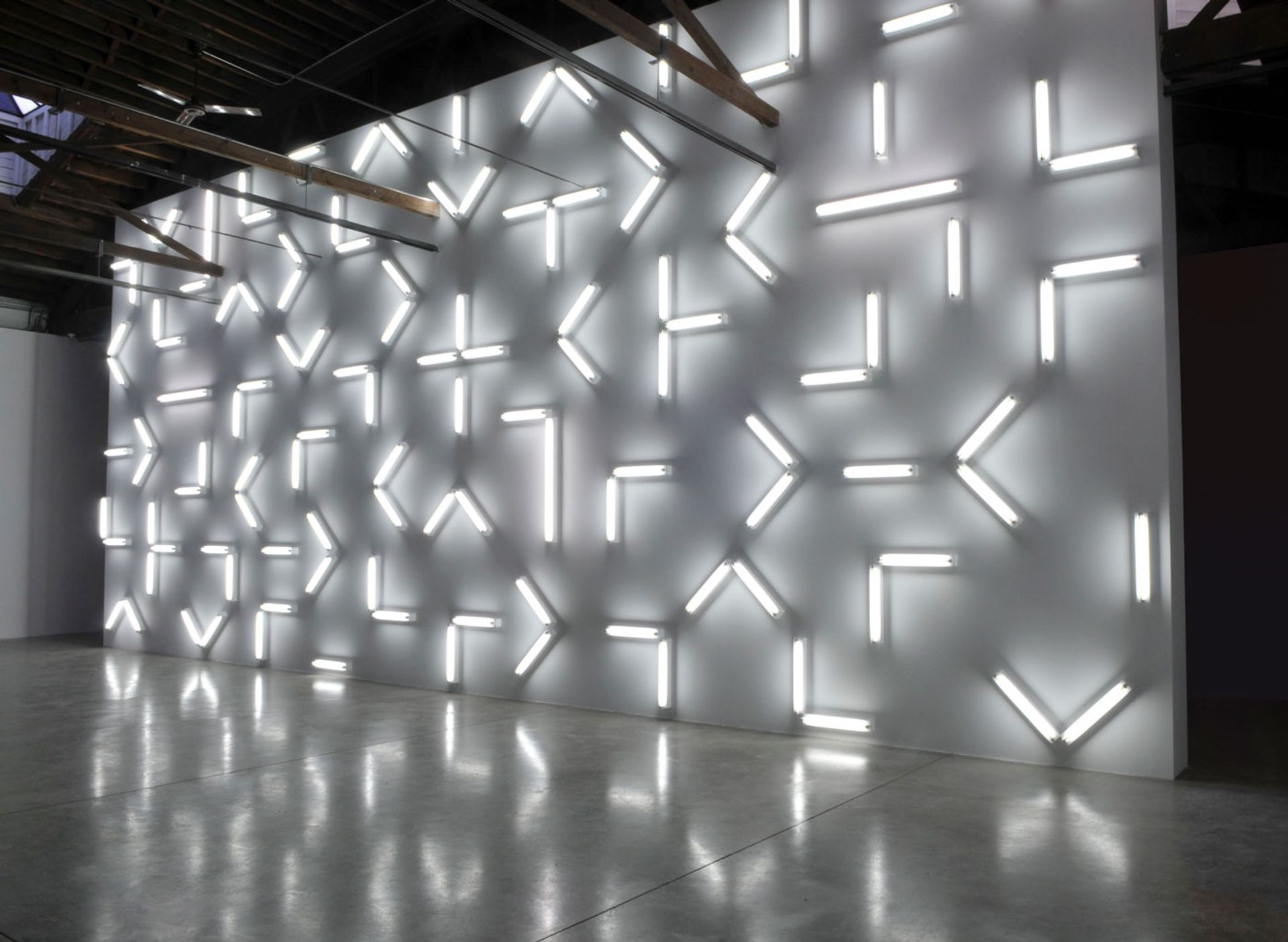
Robert Irwin, White Drawing (2008-2009 set up, with fluorescent lamps and electrical tape © Robert Irwin / Artists Rights Society (ARS)
In 1969 Irwin engaged in one other landmark second in his personal experiential voyage when the Los Angeles County Museum of Artwork (Lacma) invited him to work on sensory deprivation with the perceptual scientist Edward Wortz of the Garrett Aerospace Company, and James Turrell, who like Irwin was a member of the Mild and Area motion, recognized for its very Californian concentrate on transcendence. Turrell famously withdrew from the experiment however Irwin took copious notes. “I really feel, therefor I believe, subsequently I’m,” he as soon as mentioned.
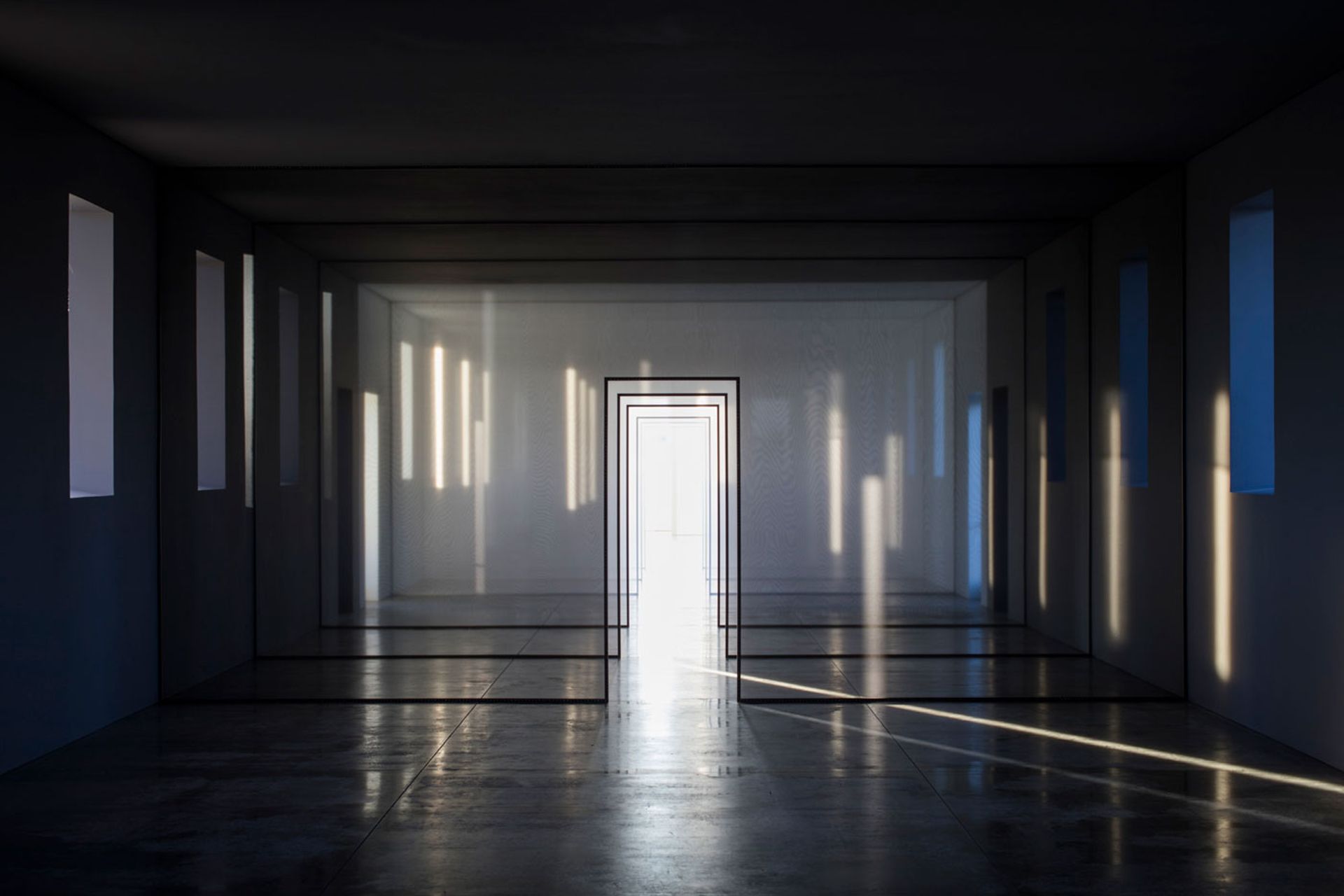
Robert Irwin, untitled (daybreak to nightfall), 2016, on the everlasting assortment, the Chinati Basis, Marfa, Texas © 2023 Robert Irwin / Artists Rights Society (ARS), New York. Picture by Alex Marks, courtesy of The Chinati Basis.
The British-born vendor Peter Goulds advised The Artwork Newspaper in 2011 how within the Nineteen Seventies, Irwin was to be discovered on the centre of ”the dialogue within the studios of Venice… animated, artist-led conferences with collectors and curators… held within the studios of Robert Irwin, Larry Bell and Sam Francis.”
Archetypical of Irwin’s work with pure mild and scrim is Black rectangle—Pure mild(1977), created for the Whitney Museum of American Artwork, New York. In 2013 Donna De Salvo, chief curator and deputy director for programmes on the Whitney, advised The Artwork Newspaper that the spotlight of her yr had been “The honour of working with Robert Irwin on the re-installation of his Scrim veil—Black rectangle—Pure mild… 36 years after it was first offered on the Whitney.” The ephemeral nature of Irwin‘s work was emphasised by the truth that the museum, quickly after, left its historic dwelling, and moved downtown to a brand new constructing within the metropolis‘s meatpacking district.
The opening of the Getty Museum in December 1997 was a really private homecoming, because the complicated is sited only a brief distance south of one in every of Irwin’s childhood houses in Los Angeles. His Primal Palm Backyard (2010), on the Los Angeles County Museum of Artwork (Lacma) has change into a metropolis landmark.
Irwin speaks of the sometimes-ephemeral nature of his work in a brand new documentary, Robert Irwin: A Desert of Pure Feeling, which has been out there on streaming providers since 20 October and is to be offered right this moment on the ICA in London. “If I say to you, you can also make one thing and it’s going to be so lovely, one of the best factor you’ve got ever achieved. Just one downside, it is solely going to final for 20 minutes…”
Robert Walter Irwin, born Lengthy Seashore California 12 September 1928; John D. and Catherine T. MacArthur Basis fellowship 1984; member, American Academy of Arts and Letters 2007; married 1956 Nancy Olsburg (marriage dissolved); died La Jolla, San Diego, California 25 October 2023.

