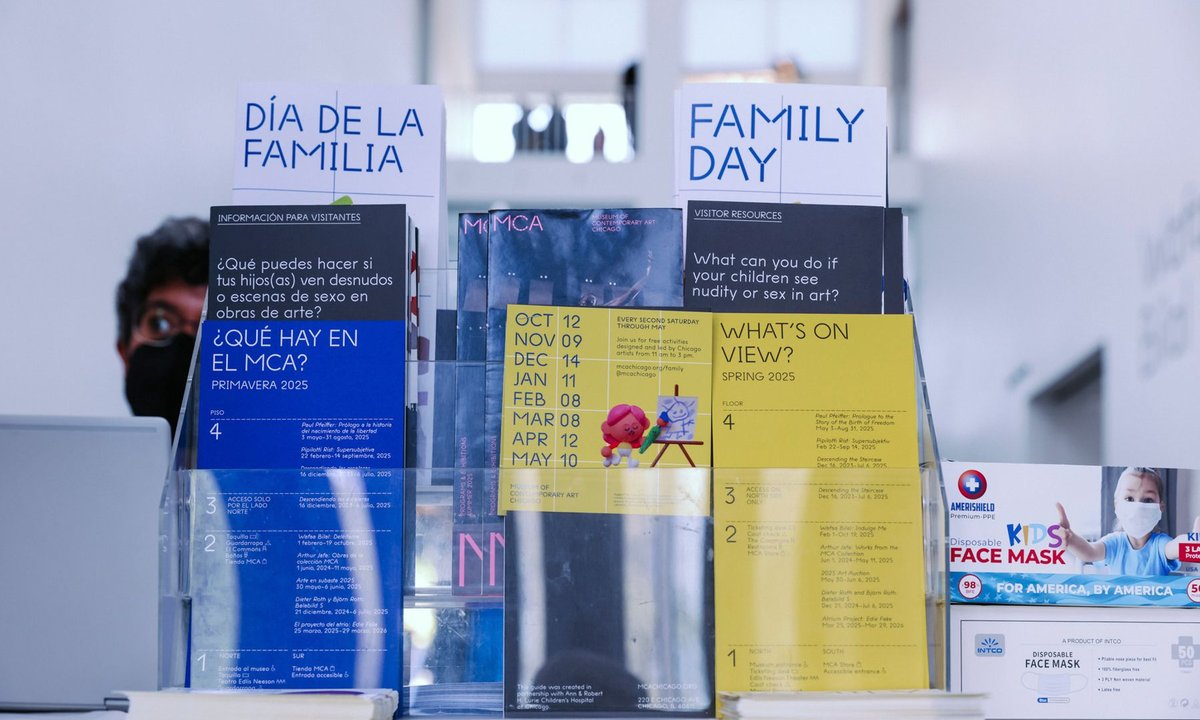
It has by no means been simpler to seek out dangerous information about US museums (or the rest on the earth, for that matter). Attendance is down, federal grants are disappearing, self-censorship is on the rise. Efforts to deal with fairness and accessibility are shedding momentum. Morale is low.
However at a second when so many issues going through US artwork establishments really feel intractable, there’s at the least one space the place they’ve made, and proceed to make, substantive progress: language entry. No, it’s not notably horny. However it’s vital.
14% of the nation’s inhabitants speaks Spanish at residence
Over the previous decade, extra museums have efficiently built-in translations—primarily, however not solely, from English to Spanish—into wall texts, web sites, wayfinding, catalogues and video captions. Forty-three million individuals, or nearly 14% of the nation’s inhabitants, communicate Spanish at residence. For museums keen to draw new audiences, that quantity represents an enormous alternative.
“With out advancing language entry, I really feel we’ll fall quick on our mission to centre artist and viewers relationships and widen the circle to incorporate as many individuals as attainable,” says Madeleine Grynsztejn, the director of the Museum of Modern Artwork Chicago (MCA), which started specializing in bilingual programming in 2020. The MCA gives Spanish translations for all in-gallery texts and is growing a bilingual web site; it additionally employed bilingual workers in key departments, together with curatorial.
The monoglots
To non-American readers, any celebration of this growth most likely appears foolish. Most museums in main worldwide cities present content material in a number of languages, together with English, as a matter after all. However the US has by no means invested in language accessibility—or language schooling—in the best way different international locations do.
The truth is, conservative activists and politicians have tried for greater than a century to cross a regulation making English the only real official language of the US, a largely symbolic gesture that nonetheless formalises anti-immigrant sentiment. In March, President Donald Trump signed an government order to this impact and rescinded an earlier one issued by President Invoice Clinton that had made it simpler for individuals with restricted English proficiency to entry authorities providers. (Trump’s order stopped wanting requiring authorities companies to cease producing paperwork in different languages.)
Making the MCA’s choices extra accessible is just good enterprise
However museums will not be pursuing language entry for symbolic, theoretical or political causes. The US is residence to the second-largest inhabitants of Spanish audio system on the earth (after Mexico). Grynsztejn factors out that Latinx individuals not solely signify 30% of Chicago’s inhabitants, however they’re its quickest rising demographic. Making the MCA’s choices extra accessible is just good enterprise.
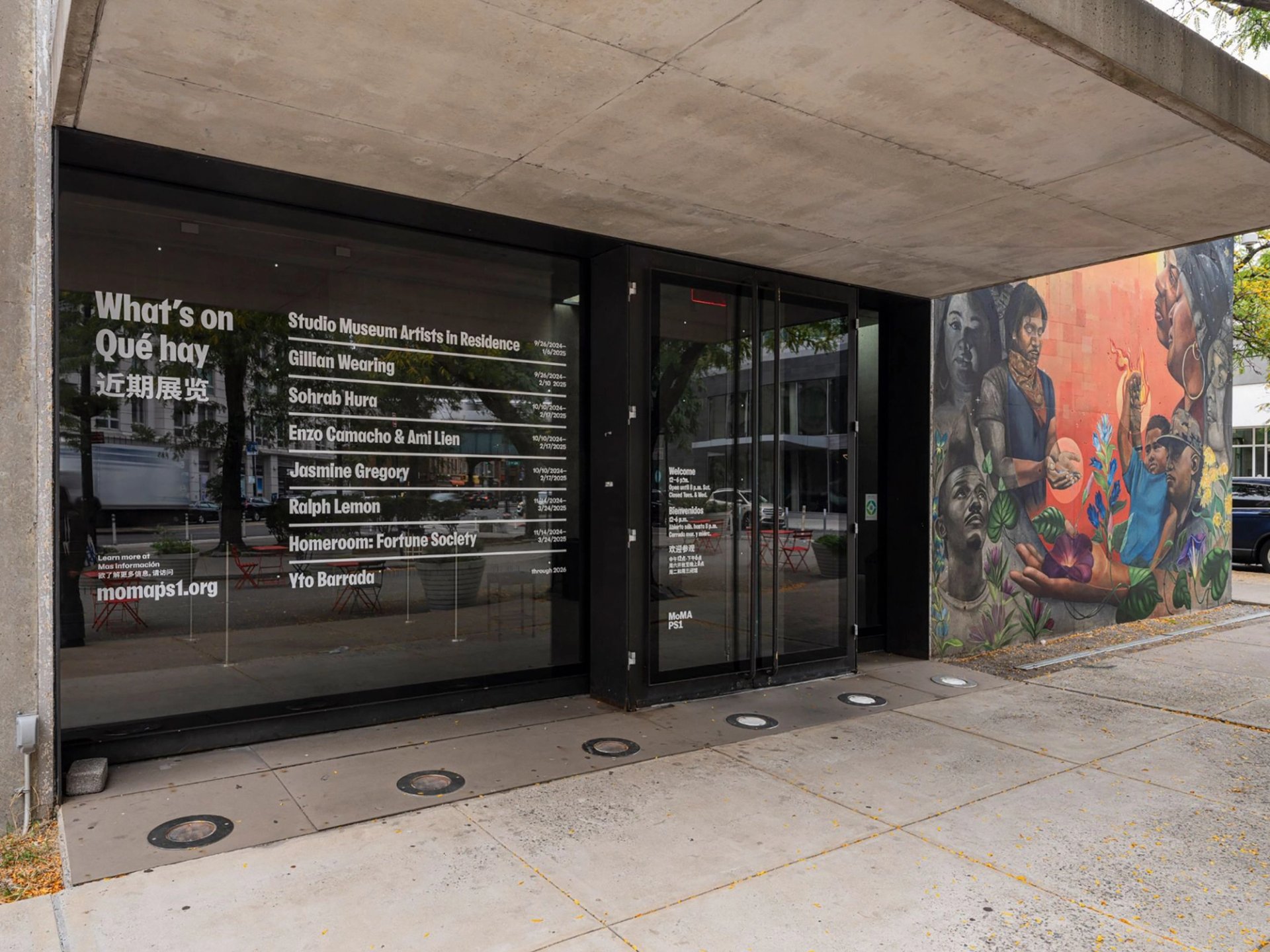
MoMA PS1 in New York has led the best way in offering exhibition texts in languages apart from English
Picture courtesy of the museum
Going past Spanish
Ever since MoMA PS1 in Lengthy Island Metropolis started specializing in language accessibility in earnest two years in the past, it has introduced exhibition supplies in not solely English and Spanish, but in addition simplified Chinese language, Arabic, Tagalog and Bisaya. (The latter 4 had been supplied for exhibitions of labor by the French Moroccan artist Yto Barrada, the feminist collective Malikah, the Filipina artist Pacita Abad and the Filipino artwork collective Little Manila Queens, respectively.)
This international perspective is especially becoming for a museum in Queens, New York, which might be essentially the most linguistically various place within the historical past of the world, based on the Endangered Language Alliance, which consulted on PS1’s strategy. For the museum’s editor Jack Radley, MoMA PS1’s language effort has confirmed that “translation is extra of an artwork than a science”. That is very true when coping with up to date artwork, through which cultural specificity is essential to understanding—and double, even triple entendres in a title or textual content will not be uncommon.
Working example: after the Puerto Rican artist Daniel Lind-Ramos learn the English translation of the Spanish-language audio information he had recorded for his PS1 present in 2023, he felt that a few of the nuances in his explicit dialect of Puerto Rican Spanish had been misplaced. So he determined to re-record the audio information in English himself. The method illustrated that “you may’t be prescriptive in your strategy—you need to strategy exhibitions case by case”, Radley says.
Language accessibility additionally raises new challenges, each sensible and theoretical. English texts are usually shorter than Spanish texts however longer than Chinese language ones, creating design issues for books, wall texts and labels. Radley says the method additionally made his group query how clearly it communicates complicated ideas throughout the board: “If we’re considering by a phrase that’s exhausting to translate into Spanish, we take one other step to suppose, ‘Is that this even accessible in English?’”
Language fairness
It’s no coincidence that language-accessibility efforts coalesced over the previous decade alongside the rise of Black Lives Matter and different equity-focused actions, which prompted US museums to think about extra critically how their programmes would possibly look if they didn’t solely centre white, English-speaking audiences. The Dallas Museum of Artwork’s bilingual initiative, for instance, encompasses the event of every part from English to Spanish wall texts to the museum’s first land acknowledgement, based on Melissa Brito-Alvarez, the museum’s supervisor of entry programmes and assets.
Various establishments, together with the MCA and MoMA PS1, seeded their language programmes with funds from the Mellon Basis. However these initiatives may enchantment to a brand new technology of impact-oriented, numbers-obsessed and equity-focused philanthropists, a few of whom will not be native English audio system.
There are many systemic issues within the museum world, from the still-overwhelming whiteness of collections to pervasive burnout and low pay. It’s refreshing to see an space the place progress could be measured in years, not a long time. Regardless of—or, maybe, due to—the darkish cloud that appears to be hovering over US establishments nowadays, it’s worthwhile to pause and acknowledge a vivid spot once we see one.

