Within the US, Frank Lloyd Wright is as near a family identify as any architect within the historical past of the nation. However valuable few Individuals are conversant in Wright’s Nineteenth-century predecessor and inspiration, the French architect Eugène Emmanuel Viollet-le-Duc (1814-79). That will change slightly this month, when the Bard Graduate Heart in New York opens the primary main present about him within the US.
A fantastic and utilized arts polymath, in addition to a mystically inclined visionary, Viollet-le-Duc, a local Parisian from a household of artists and high-ranking civil servants, is well known in France for overseeing the preservation and restoration of a number of the nation’s most necessary Medieval buildings and monuments, together with the cathedral of Notre-Dame de Paris. However he was additionally a theoretician and a gadfly, and had an immense influence, not solely on the route of structure, however on how the current can and will regard the previous. The Bard exhibition will present greater than 150 of his drawings to realize perception into his fertile creativeness and industrious working strategies.
Counting on quite a few French sources, particularly the archives of the Médiathèque du patrimoine et de la photographie, Viollet-le-Duc: Drawing Worlds will span 5 many years, beginning together with his fanciful teenage depictions of French harbours and culminating in late ruminations on Medieval weaponry.
The curators have had a wealth of fabric to select from—the Médiathèque alone holds some 20,000 of his drawings. Viollet-le-Duc was a “compulsive” draughtsman, explains Martin Bressani, an emeritus professor of structure at McGill College in Montreal. The Canadian is co-curating the present with Barry Bergdoll, an artwork historical past professor at Columbia College.
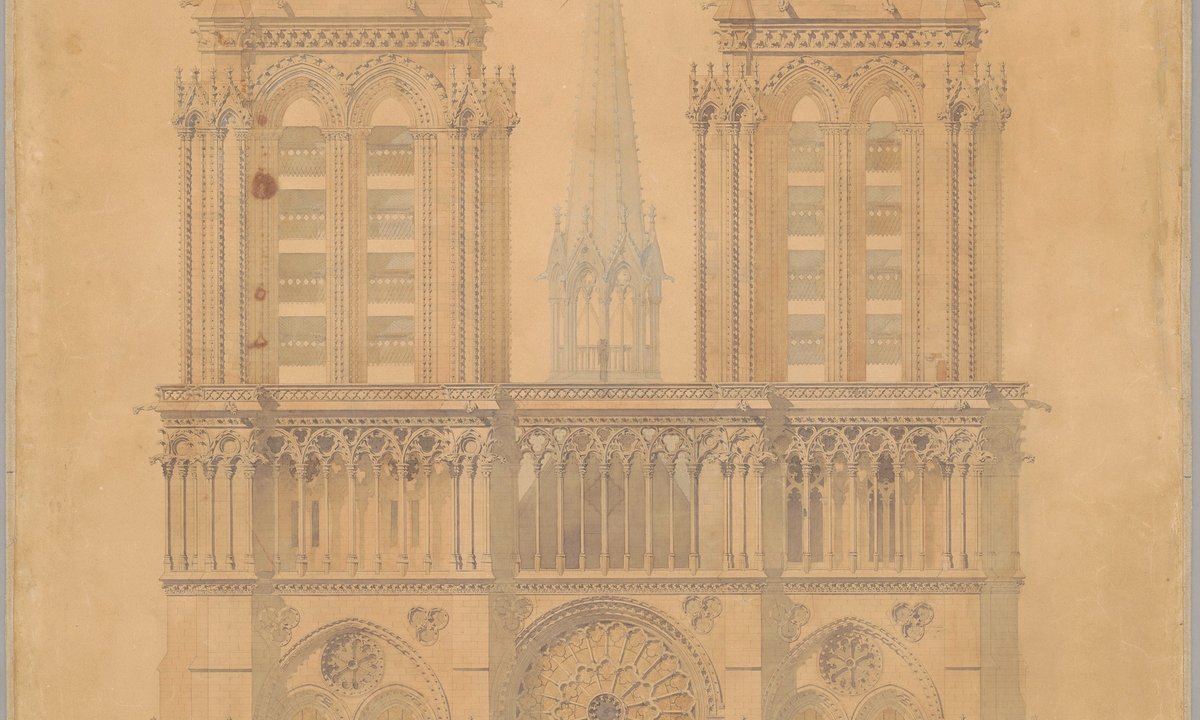
Viollet-le-Duc is credited with each reviving and reinventing Notre-Dame within the 1850s, when he helped oversee an altering restoration of the cathedral that included designing and putting in a extremely distinctive spire. His towering oak spire, whereas meant to switch a extra modest Medieval model that had been dismantled on the finish of the 18th century, was the Frenchman’s meditation on an idealised previous moderately than a recreation of what had as soon as been. This dynamic strategy to historic preservation—and, certainly, to historical past itself—is what so impressed Wright and others.
Following the close to destruction of the cathedral in a 2019 fireplace, Viollet-le-Duc’s model was, considerably sarcastically, faithfully remade and changed. And the reopening of Notre-Dame final yr is an event for the present, Bressani says.
A proto-Modernist?
Fittingly, the exhibition is wealthy in beautiful plans and interpretations of the cathedral, which mesmerisingly merge the Center Ages with a form of proto-
Modernist—or least technically astute—eye. An 1857 presentation drawing, exhibiting the spire in elaborate isolation, by some means anticipates the Eiffel Tower.
Viollet-le-Duc’s interventionist strategy has had its critics. He was “really vilified within the early twentieth century,” Bressani says. And a few of his drawings vividly illustrate how he seen preservation as an basically artistic act.
Carcassonne, the fortified Medieval metropolis within the south of France, was restored by Viollet-le-Duc at across the identical time he was engaged on Notre-Dame, and an 1853 ink and watercolour drawing bizarrely captures the fortress in each its authentic and restored states in a single picture. The unique, hovering on the backside, seems to be like a vanquished imaginative and prescient of the reinvented city.
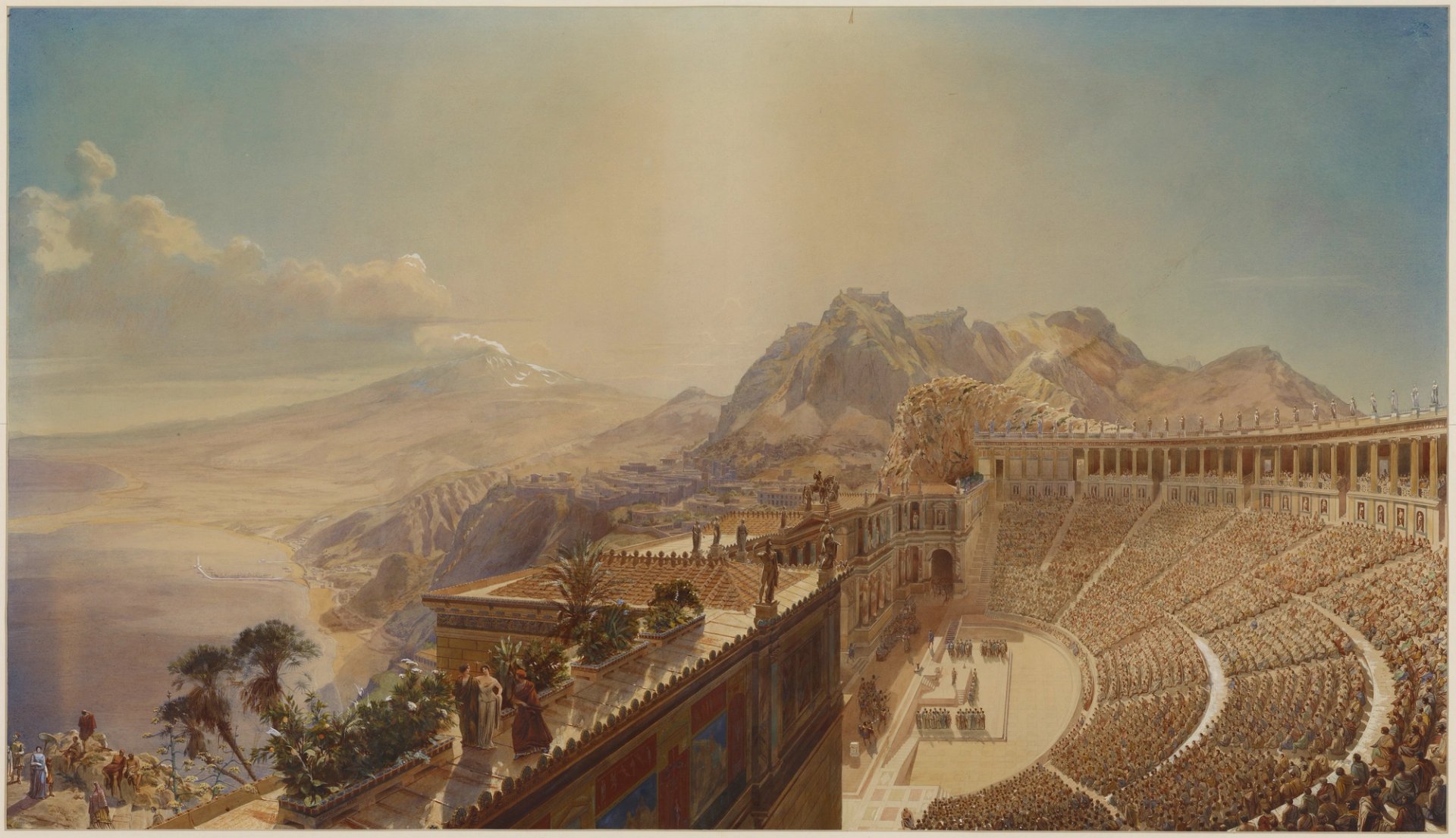
Making the silent stones converse: Viollet-le-Duc’s 1840 drawing of the vintage theatre at Taormina in Sicily integrated the efficiency of a classical Greek drama © Grand Palais
One stunning side of the present, even for students conversant in his architectural works, might be how Viollet-le-Duc turned his revising instincts on the pure world. Close to the top of his life, he made journeys up into the French Alps, and a pair of associated drawings distinction a glacier ridge close to Chamonix, because it existed in August 1874 throughout his go to, with a imaginative and prescient of it “restored” in an imaginary Ice Age.
This intuition to remake the previous predates his working life as an necessary architect within the France of the Second Empire. An 1840 color drawing, achieved in response to a go to to Sicily, totally restores Taormina’s historic Greek theatre to a flourishing classical state, replete with a play in mid-performance.
Viollet-le-Duc had a darkish and pseudo-scientific aspect, Bressani concedes. Drawn to the racialist theories of his pal, Arthur de Gobineau, who’s credited with first expounding the concept of a superior “Aryan” race, Viollet-le-Duc was additionally fascinated by army prowess, which discovered expression within the exact and menacing warfare drawings that assist wind down the present.
By means of demonstrating his eccentricity, the curators have included his custom-built desk—a curious-looking contraption that appears to mix a working floor with a bookcase and a few drawers, making a near-organic object that solely an animator may in any other case try. Viollet-le-Duc preferred to take a seat in it, Bressani says, “whereas wearing a Medieval gown”.
• Viollet-le-Duc: Drawing Worlds, Bard Graduate Heart, New York, 28 January-24 Could

