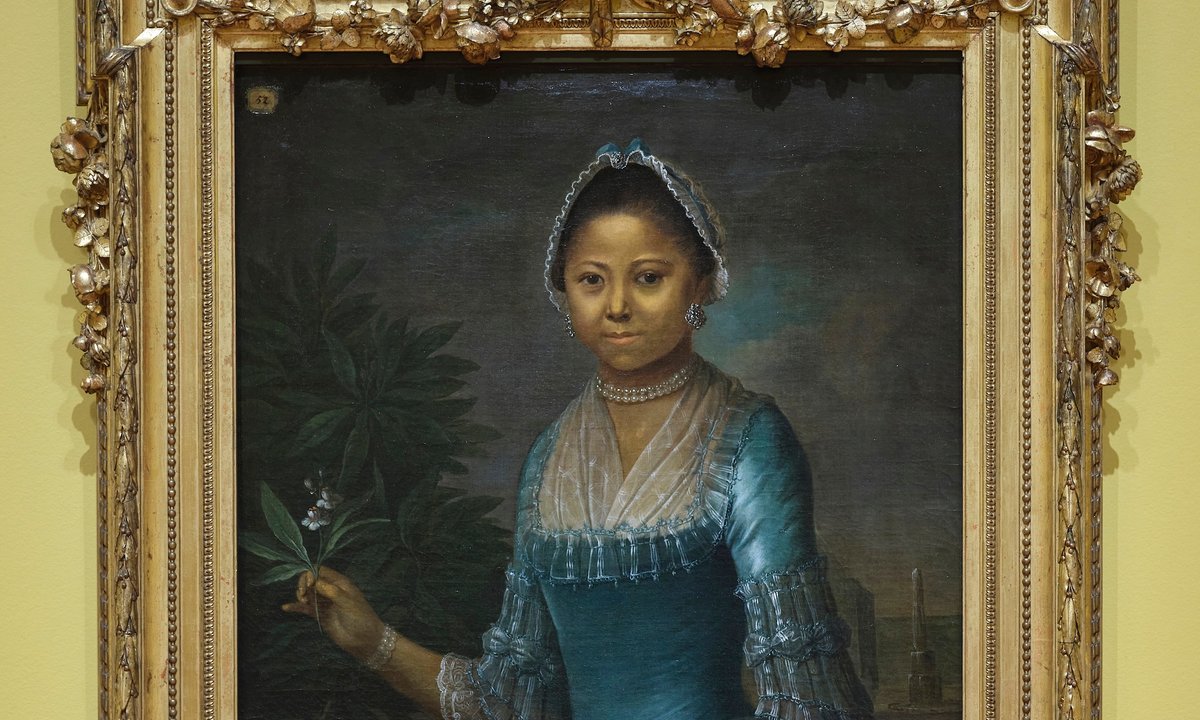
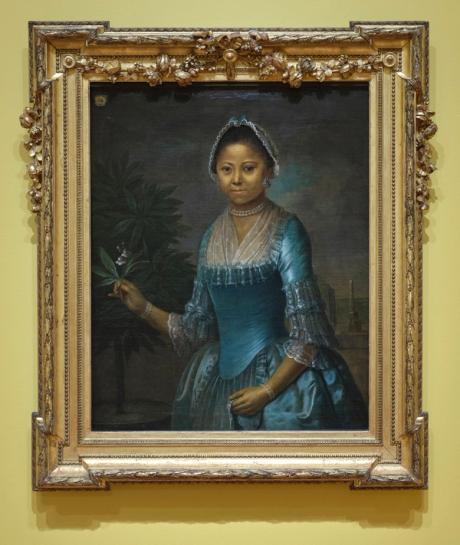
Each the painter and the sitter of a portrait of a younger lady of color bought at public sale by the Artwork Gallery of Ontario (AGO) in 2020 have lastly been recognized after a number of digging, somewhat luck and a reframing. The primary identify of the portray’s topic is Eleonora Susette (her final identify stays unknown); she was born round 1756 in Berbice, a Dutch colony identified for sugar and molasses in what’s now Guyana. The artist is the Berlin-born artist Jeremias Schultz (1722-1800).
Whereas nonetheless a teen, Eleonora Susette was enslaved and made to work alongside her mom for the colony’s governors. Within the portrait she is elegantly dressed, sports activities tremendous jewelry and has a assured bearing. She holds an orange blossom, therefore the portray’s former title, “Portrait of a Woman Holding an Orange Blossom”. Now that she has been recognized, the piece has been retitled Portrait of Eleonora Susette (1775).
Attempting to establish her and the painter posed a problem for Adam Harris Levine, the AGO’s affiliate curator of European artwork, and Monique Johnson, the gallery’s former interim affiliate curator of European artwork. There was not a lot to go on, although there was a partial signature on the work—“J.Schul…fec”. One other work attributed to Schultz, this certainly one of a younger man of color who can also be elegantly outfitted, often known as Portrait of a younger man sporting a inexperienced jacket holding a cane, proved useful in figuring out Eleonora Susette. (That work is held in a non-public assortment.)
After round a yr of analysis, Johnson was capable of establish the artist as Schultz, who was primarily energetic within the Netherlands and usually painted portraits of retailers of the then-thriving Dutch colonial empire. However from there analysis stalled, as comparatively little is thought about Schultz’s life and work, and the Dutch colonies had been quite a few and extensively dispersed—numbering practically 30 on the top of the empire.
“We had been on the lookout for two younger individuals of color who had been dwelling in Amsterdam within the 1770s and would have event to be painted by Jeremias Schultz,” Levine just lately advised the AGO’s in-house journal, Lobby. “That, frankly, felt like a whole useless finish to me.”
Even so, he and Johnson stored trying. “We tried many alternative theories,” he tells The Artwork Newspaper. “Then this unimaginable electronic mail got here.” It was from a mom and her son within the Netherlands, with ties to the artist.
They wrote {that a} direct ancestor, Beata Louise Schultz, was the artist’s first cousin. Beata and her husband, who had been named governor of the colony, moved to Berbice in 1768. He died a couple of years later, in 1773, prompting her to return to Amsterdam with two enslaved individuals, certainly one of them being Eleonora Susette.
Again in Amsterdam, she requested her cousin to color portraits of her son and daughter, and in addition of Eleonora Susette and the person within the inexperienced jacket, named Michiel. Lower than a yr later, Eleonora Susette and Michiel had been despatched again to Berbice. Crisscrossing the Atlantic in these days was dangerous. “It will have been scary and harmful,” Levine says.
He provides: “Folks have a deep affinity for the portray. Toronto is house to a big Caribbean neighborhood. It’s gotten an incredible buzz.”
As for the remainder of Eleonora Susette’s story, the curators’ analysis is ongoing. “It’s too unhealthy if all we are able to share are the small print as much as her return to Berbice,” Levine says. “It looks like solely a part of the story. Analysis continues to be ongoing. I’ll really feel even higher after we can share the story in its fullness.”
Schultz’s portrait of Eleonora Susette is now on show, with its up to date title and attribution, in gallery 123 on the AGO’s floor degree.

